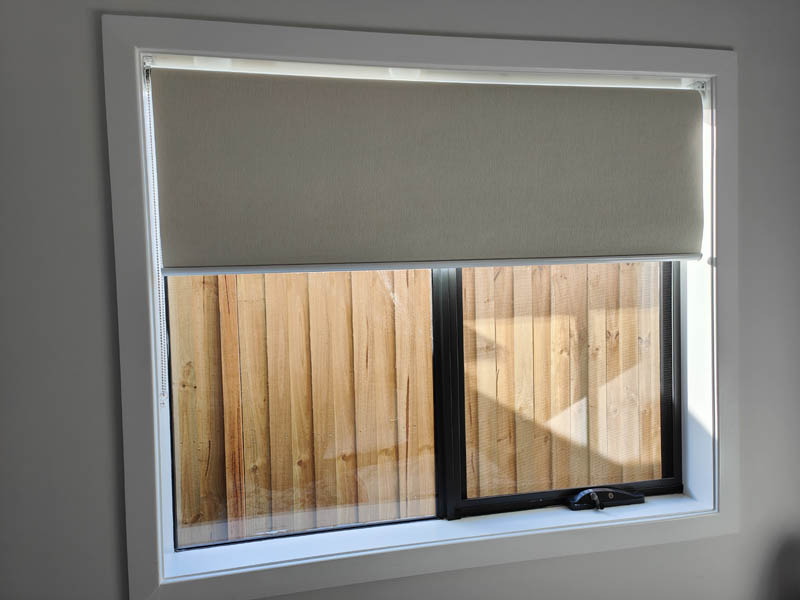
It is the first question on almost every roller blind quote, and it gets answered far too quickly. Block-out or light-filtering is not a quality decision — one is not the upgrade of the other. They do different jobs, and most houses need both.
What block-out actually does
Block-out fabric fully prevents light from entering. Pull it down and the room goes dark, at any hour, regardless of what the sun is doing outside. That makes it the answer for bedrooms and media rooms, where you want complete control of light and proper privacy after dark.
It earns its keep in two situations in particular: shift workers who need to sleep through daylight, and anyone sensitive to early morning light — which, in a region that gets genuinely bright summer mornings, is more people than you would think.
What light-filtering actually does
Light-filtering fabric does the opposite of blocking. It softens and diffuses daylight rather than stopping it, so the room stays bright while the glare comes down. You still get privacy during the day, and you keep the sense of a window rather than a covered hole in the wall.
That suits living areas and kitchens: rooms you use in daylight, where cutting glare on a screen or a benchtop matters more than being able to make the room dark.
The one thing people are surprised by: light-filtering gives you privacy in the day, when it is brighter outside than in. After dark with the lights on, that flips — shapes become visible from outside. If a room needs privacy at night, that room wants block-out.
You can mix them — and most people should
There is no rule that a house picks one. Most homeowners choose block-out for the bedrooms and light-filtering for the living spaces, and we quote them that way as standard: one fabric decision per room, not one for the whole job.
A rough starting point, before we have seen the place:
- Bedrooms — block-out, almost always
- Media rooms — block-out, for the same reason plus screen glare
- Living areas — light-filtering, unless the room doubles as a media room
- Kitchens — light-filtering, to keep the bench bright
- Bathrooms — block-out if it is overlooked, otherwise either
Colour changes the answer too
Within each type there is a range of fabrics, colours and opacity levels, and the colour is not only a decorating choice. A lighter fabric bounces more light back into the room; a darker one absorbs it and cuts glare harder while making the room feel closer. Worth handling samples in the actual room rather than choosing from a photo.
Does it change the price?
Not dramatically. Roller blinds are one of the most cost-effective window treatments we fit, in either fabric, while still being custom-made to your exact window. The decision is about how each room is used, not about stretching a budget.
How to decide without overthinking it
Walk through the house and ask one question in each room: do I ever need this room dark? If yes, block-out. If no, light-filtering. That gets you 90% of the way, and we will settle the rest at the free measure — room by room, with the samples in hand.